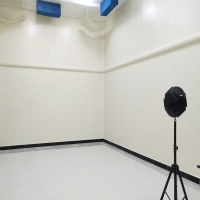






The Reverberation Chamber and On-site Test & Acceptance of Hebei University of Engineering
Introduction to the Acoustic Design, Manufacturing, Construction & Installation of the Reverberation Chamber and On-site Test & Acceptance of Hebei University of Engineering
Hebei University of Engineering is a key backbone university in Hebei Province, a university jointly built by the People's Government of Hebei Province and the Ministry of Water Resources, a university in the second tier of Hebei Province's national first-class university construction, and a civilized unit in Hebei Province. It is located in Handan City, a famous historical and cultural city in China and the "hometown of idioms and allusions". Committed to improving teaching quality and cultivating pillars of the country, the university has procured an acoustic laboratory project to enhance its academic research and talent training capabilities in the field of acoustics.
GZ DP Anechoic T&E Co., Ltd., a professional enterprise with profound expertise in acoustic technology, undertakes the design, manufacturing, construction and installation of Hebei University of Engineering's acoustic laboratory project—with the reverberation chamber being a core component of this project. The company is composed of a team of acoustic experts and professional engineers who have long been engaged in the research of various acoustic technologies at home and abroad, boasting rich theoretical knowledge and practical experience. It owns its own office building and factory, and the factory is equipped with an acoustic laboratory that meets CNAS standards. This laboratory not only enables the company to monitor the acoustic technical indicators of its own products but also provides external acoustic testing services. Through the unremitting efforts of the DP team and continuous innovation and development, the acoustic laboratory projects (including reverberation chambers) designed, produced and installed by the company feature accurate technical indicators, green and environmental protection, durable quality, beautiful appearance and high technological content. During the construction of Hebei University of Engineering's acoustic laboratory, the company also applied all or part of its patented "turbocharged microcirculation frequency conversion silencing ventilation" technology (Patent No.: 200520108948.5) to the reverberation chamber and other sub-projects, ensuring the excellent performance of the laboratory.
The reverberation chamber is a special acoustic laboratory with a strong sound reflection environment inside. It is not only an important platform for acoustic teaching, scientific research and product testing in Hebei University of Engineering but also plays a crucial role in improving the university's acoustic research level and cultivating high-quality acoustic professionals. The following is a detailed introduction to the procurement content, compliance standards, main indicators, on-site test and acceptance of the reverberation chamber of Hebei University of Engineering.
1. Procurement Content
The procurement content of the acoustic laboratory project of Hebei University of Engineering includes multiple core acoustic chambers, among which the reverberation chamber is a key part. GZ DP Anechoic T&E Co., Ltd. is fully responsible for the overall design, material selection, manufacturing, on-site construction and installation of the reverberation chamber, and provides follow-up quality assurance, warranty, maintenance and technical support services after the completion and acceptance of the project. The installation location of the reverberation chamber is within the new campus of Hebei University of Engineering.
2. Compliance Standards
The design, manufacturing, construction and performance indicators of the reverberation chamber of Hebei University of Engineering comply with relevant national and industry acoustic standards, ensuring the scientificity, accuracy and applicability of the reverberation chamber in acoustic testing and research. The main compliance standards include but are not limited to:
- National and industry standards for acoustic laboratories and reverberation chambers, ensuring that the structure, acoustic performance and safety performance of the reverberation chamber meet the requirements of formal acoustic testing and teaching research.
3. Main Indicators and Project Content
3.1 Basic Configuration and Structural Indicators
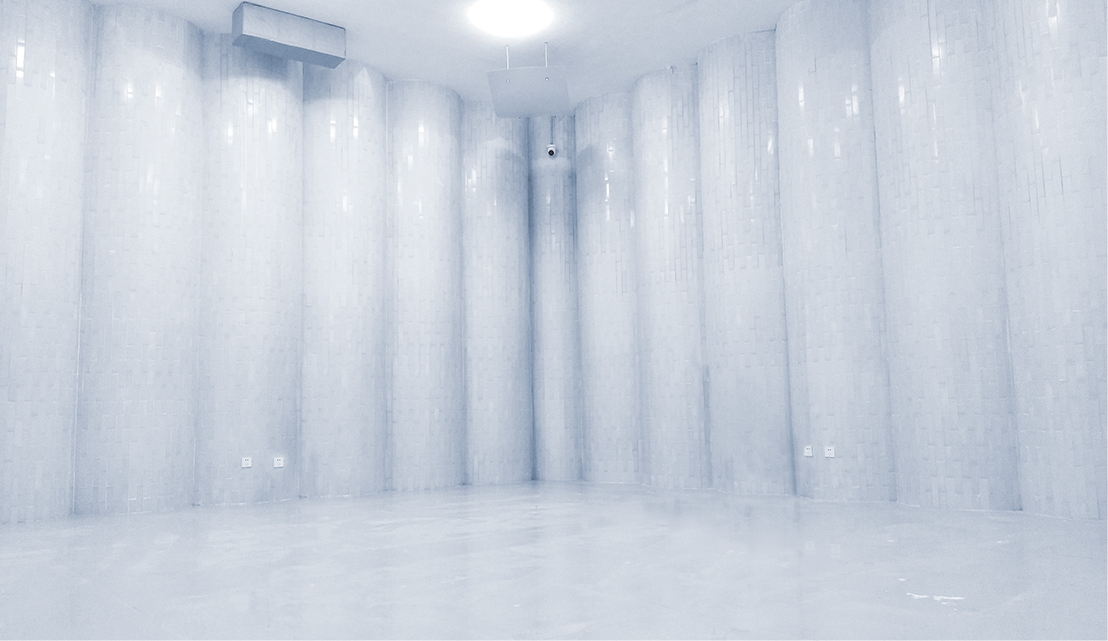
- Internal Effective Net Size: The internal effective net size of the reverberation chamber is 8150mm × 8160mm × 4550mm, providing a sufficient internal space to meet the needs of different types of acoustic tests and research.
- Supporting Facilities: To ensure the normal operation of the reverberation chamber in teaching and testing scenarios, 6 professional echo-free and noise-free lighting lamps are installed inside the chamber to provide stable and non-interfering lighting; at the same time, 3 2-hole/3-hole sockets are configured to meet the power demand of testing instruments and equipment.
- Personnel Access Door: The size of the personnel access door of the reverberation chamber is designed as W × H = 1.2m × 2.0m, which is convenient for personnel to enter and exit and for the movement of small testing equipment, while ensuring the acoustic sealing performance of the chamber.
3.2 Core Acoustic Performance Indicators
The acoustic performance indicators of the reverberation chamber directly determine its application scope and testing accuracy. The main core acoustic performance indicators are as follows:
- Background Noise Requirement: Under the condition of no external abnormal interference and the external noise Len(A) ≤ 60dB(A), the background noise Lgn(A) inside the reverberation chamber shall be ≤ 20dB(A), ensuring that the chamber has a low-noise environment to avoid interference with acoustic tests.
- Sound Field Uniformity Requirement: The sound field uniformity inside the reverberation chamber is an important indicator to ensure the accuracy of test results. For different frequency bands, the requirements are: - When the frequency is in the range of 100Hz - 315Hz, the sound field uniformity Sm ≤ 3dB; - When the frequency is ≥ 400Hz, the sound field uniformity Sm ≤ 1.5dB.
- Reverberation Time Requirement: The reverberation time of the reverberation chamber shall meet T60 > V/S (where V is the volume of the reverberation chamber and S is the internal surface area of the chamber), and the actual required reverberation time T60 > 1.1s, ensuring that the chamber can form a stable and uniform reverberation environment.
4. On-site Test and Acceptance
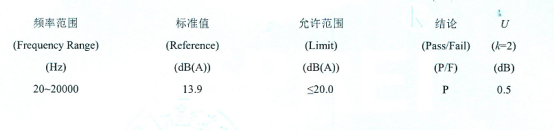
After the completion of the design, manufacturing and on-site construction and installation of the reverberation chamber, a professional metrology institute was commissioned to conduct on-site test and acceptance to verify whether the performance indicators of the reverberation chamber meet the design requirements and standard specifications.
A) ≤ 20dB(A)", the measured value is far lower than the standard limit (with a allowable deviation of 0.5dB under k=2).
- Acceptance Conclusion
Based on the comprehensive test of the reverberation chamber's performance indicators, the metrology institute confirmed that all calibrated items of the reverberation chamber of Hebei University of Engineering meet the design requirements and relevant standards. The final acceptance conclusion is qualified (Pass, marked as "P").
 Completed Photos
Keywords:Reverberation chamber, acoustic laboratory, background noise, sound field uniformity, reverberation time, Hebei University of Engineering, GZ DP Anechoic T&E Co., Ltd.
Leave your reply
Your email address will not be published. Required fields are marked *